Vacuum vs. Mechanical Grippers for Palletizing
A palletizing robot is only as effective as the tool it uses to handle products. The robot provides the movement, reach, and payload capacity, but the end-of-arm tooling determines whether each carton, bag, tray, pail, or component can be picked and placed reliably.
Two of the most common technologies used in robotic palletizing are vacuum grippers and mechanical grippers. Both can deliver dependable performance, but they operate differently and are suited to different products.
Vacuum grippers are frequently selected for cartons and packages with suitable surfaces. Mechanical grippers are often preferred for porous, heavy, irregular, or difficult-to-grip products. Some applications benefit from hybrid tools that combine both technologies.
This guide compares vacuum and mechanical grippers and explains the factors manufacturers should evaluate when selecting palletizing end-of-arm tooling.
What Is a Palletizing Gripper?
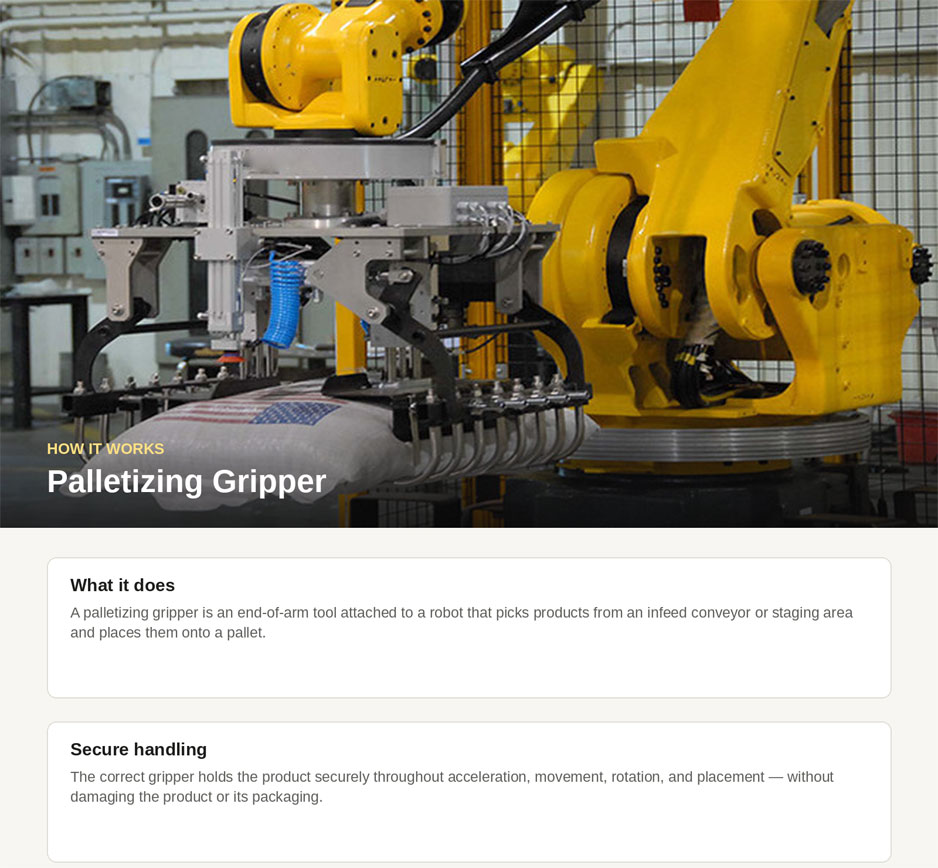
A palletizing gripper is an end-of-arm tool attached to a robot that picks products from an infeed conveyor or staging area and places them onto a pallet.
The terms "gripper," "robotic gripper," and "end-of-arm tooling," or EOAT, are often used interchangeably. However, EOAT can describe the complete tool assembly, including:
The correct gripper must hold the product securely throughout acceleration, movement, rotation, and placement without damaging the product or its packaging.
Gripper selection affects:
For this reason, gripper engineering should be treated as a central part of palletizing system design—not as an accessory selected after the robot.
What Is a Vacuum Gripper?
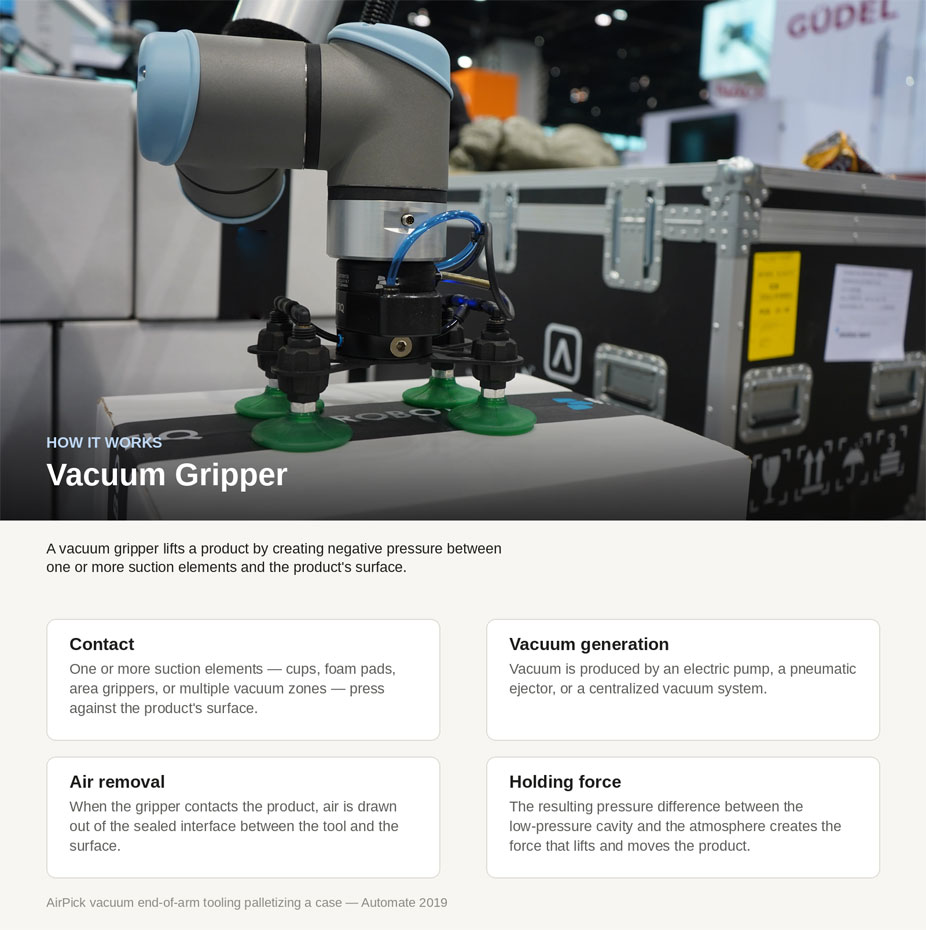
A vacuum gripper lifts a product by creating negative pressure between one or more suction elements and the product's surface.
The tool may use individual suction cups, foam pads, area grippers, or multiple vacuum zones. Vacuum can be generated by an electric pump, a pneumatic ejector, or a centralized vacuum system.
When the gripper contacts the product, air is removed from the interface. The resulting pressure difference creates the holding force needed to lift and move the product.
Products commonly handled by vacuum grippers
Vacuum grippers are widely used for:
Vacuum gripping is especially effective when the product has a reasonably flat, accessible surface and its packaging can maintain enough vacuum to support the load.
Advantages of Vacuum Grippers
Fast pick-and-place cycles. Vacuum tools can grip and release products quickly. This makes them suitable for high-throughput palletizing applications.
Simple product contact. The tool generally makes contact with only one surface, such as the top of a carton. It may not need to reach around the sides or underneath the product. This can simplify conveyor presentation and allow products to be placed close together on a pallet.
Flexibility across product sizes. A large foam-pad or multi-zone vacuum gripper may handle several carton sizes without a mechanical changeover. Unused vacuum zones can be deactivated or designed to compensate automatically for partial coverage.
Gentle handling. Vacuum cups and foam pads can handle products without squeezing their sides. This is useful for packages that may be damaged by clamping pressure.
Multiple-product picking. A properly designed vacuum tool can lift multiple cartons, containers, or an entire product layer in one cycle. Multi-picking can significantly increase cell throughput.
Compact tool design. Because the tool normally approaches from above, a vacuum gripper may require less clearance around the sides of the product.
Limitations of Vacuum Grippers
Dependence on surface condition. Vacuum performance can be affected by porous cardboard, uneven surfaces, gaps, seams, tape, wrinkles, dust, moisture, oil, damaged packaging, and perforated materials. A gripper that performs well on one carton sample may behave differently when packaging quality varies in actual production.
Air leakage. Porous materials allow air to pass through the product surface. The vacuum system must compensate for this leakage while maintaining sufficient holding force.
Energy consumption. Pneumatic vacuum generators can require a continuous supply of compressed air. Poorly sized systems or undetected leaks may increase operating costs.
Sensitivity to product deformation. Flexible lids, thin cartons, and loosely filled bags may deform during lifting. Deformation can break the vacuum seal or affect product placement.
Vacuum-loss risk. A loss of vacuum may cause the product to slip or fall. Good systems therefore incorporate vacuum monitoring, check valves, reservoir capacity, and fault-handling logic.
What Is a Mechanical Gripper?
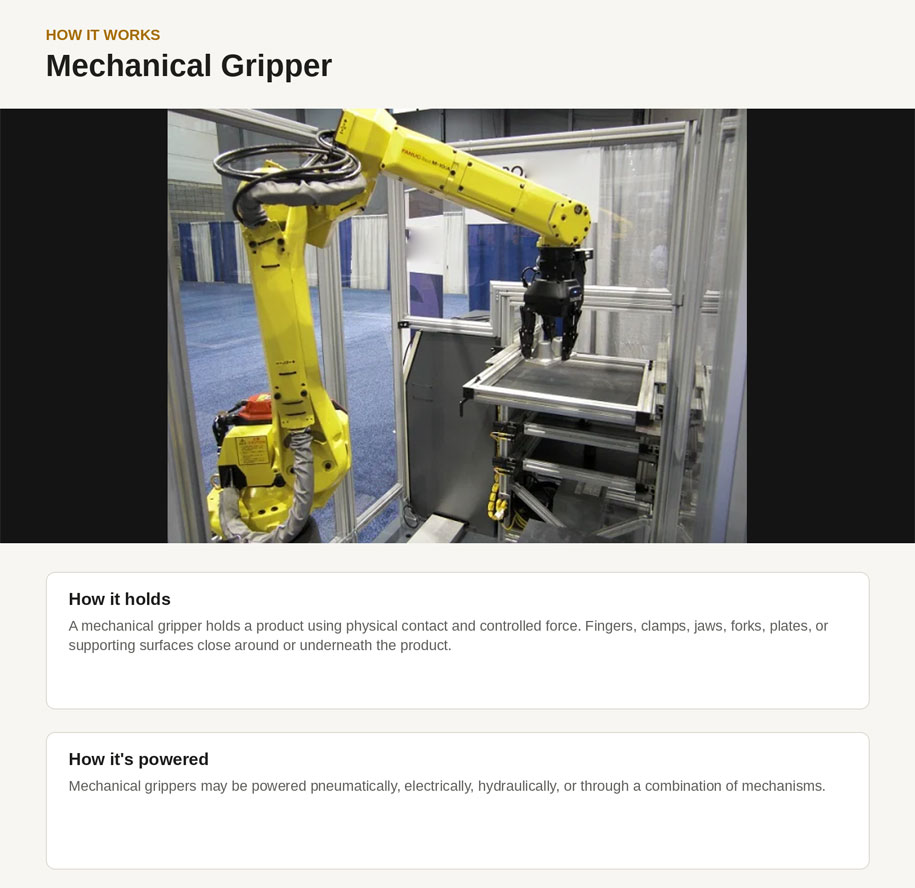
A mechanical gripper holds a product using physical contact and controlled force. Fingers, clamps, jaws, forks, plates, or supporting surfaces close around or underneath the product.
Mechanical grippers may be powered pneumatically, electrically, hydraulically, or through a combination of mechanisms.
Unlike a vacuum tool, a mechanical gripper does not rely on an airtight seal. It can therefore handle products with porous, irregular, textured, or damaged surfaces.
Products commonly handled by mechanical grippers
Mechanical grippers are frequently used for:
The design may grip the sides of the product, support it from below, or use both methods.
Advantages of Mechanical Grippers
Reliable handling of porous products. Mechanical tools do not need an airtight product surface. They can handle breathable bags, rough materials, perforated crates, and poorly sealed cartons.
Support for heavy loads. Forks and under-support mechanisms can carry heavy products without relying entirely on surface adhesion.
Better control of irregular products. Custom fingers and support structures can be designed around a product's geometry, handles, rims, or lifting points.
Resistance to packaging variation. Mechanical gripping may be less affected by dust, tape placement, printing, porosity, and small variations in surface quality.
Secure handling during dynamic motion. A well-designed mechanical grip can restrain the product during high acceleration, directional changes, or rotation.
Reduced dependence on compressed air. Electrically driven mechanical grippers can reduce or eliminate the compressed-air requirements associated with some vacuum systems.
Limitations of Mechanical Grippers
Risk of product damage. Excessive clamping force can crush cartons, mark surfaces, deform containers, or damage the contents. Gripping force and contact pressure must be carefully controlled.
More product clearance may be required. Side-clamping fingers need space around the product. Closely spaced products may need to be separated before gripping.
Greater mechanical complexity. Mechanical tools may include actuators, bearings, linkages, guides, and moving fingers. These components can increase tool weight and maintenance requirements.
Product-specific design. A tool shaped around one product may not handle a significantly different product without adjustment or changeover.
Longer gripping sequence. The robot may need to approach, position the fingers, close the gripper, confirm the grip, and then lift. This can add time compared with a simple vacuum pickup.
Vacuum vs. Mechanical Grippers: Quick Comparison
Neither technology is universally better. The right choice depends on the product and the required operating conditions.
| Selection factor | Vacuum gripper | Mechanical gripper |
|---|---|---|
| Best suited to | Flat or sealable surfaces | Porous, irregular, or heavy products |
| Typical products | Cartons, trays, sheets and wrapped packs | Bags, crates, pails and heavy products |
| Gripping method | Negative pressure | Clamping or physical support |
| Product clearance | Usually minimal | Often required around the sides |
| Packaging sensitivity | Sensitive to leaks and surface quality | Sensitive to dimensions and clamping force |
| Product damage risk | Surface marking or deformation from suction | Crushing, scratching, or side deformation |
| Speed | Often very fast | Application-dependent |
| Multi-picking | Generally straightforward | Possible with a custom design |
| Tool weight | Often relatively low | May be higher |
| Maintenance | Cups, foam, filters and vacuum lines | Fingers, actuators, bearings and linkages |
| Energy source | Electric vacuum or compressed air | Pneumatic, electric, or hydraulic |
| Changeover flexibility | High with zoned area grippers | Depends on finger adjustment and tool design |
How to Choose Between Vacuum and Mechanical Grippers
1. Evaluate the product surface
A smooth, nonporous, accessible surface generally favors vacuum gripping. Mechanical gripping may be more reliable when surfaces are porous, textured, curved, wet or dusty, perforated, easily wrinkled, or inconsistent between batches. Testing should use production-quality samples, including packages representing acceptable worst-case conditions.
2. Consider product weight and center of gravity
The gripper must create enough holding force to support the product during the robot's complete motion profile. Engineers must consider more than static product weight. Acceleration, deceleration, rotation, emergency stopping, load orientation, safety factors, and an offset center of gravity can all increase the required gripping force. For vacuum tools, the available contact area and achievable vacuum level affect holding capacity. For mechanical tools, gripping force, friction, jaw geometry, and bottom support must be evaluated.
3. Examine packaging strength
The packaging must tolerate the gripping method. A vacuum tool may pull or deform a weak panel. A mechanical clamp may crush a lightly constructed carton. Packages containing fragile goods may require distributed contact pressure, compliant materials, or bottom support.
4. Determine the required throughput
The target production rate influences whether products should be picked individually, in groups, by rows, or as complete layers. Vacuum area grippers often perform well in multi-pick applications. Mechanical multi-pick tools are also possible but may require more complex arrangements. The complete cycle must account for product arrival, gripper positioning, grip confirmation, robot movement, product placement, gripper release, pallet changes, and slip-sheet handling.
5. Review the product range
A facility processing one standard carton may benefit from a simple, dedicated tool. A line processing many product sizes may require zoned vacuum control, servo-adjustable fingers, interchangeable contact components, an automatic tool changer, or a multifunction gripper. The required changeover time should be defined before the tool is designed.
6. Consider pallet-pattern requirements
The gripper must be able to place products at the required orientation and spacing. Side-clamping fingers can interfere with adjacent cartons when products must be packed tightly. A vacuum gripper may provide better access from above. Conversely, an under-support mechanical tool may be necessary when the product cannot safely be held from its top surface.
7. Check utilities and energy availability
A vacuum system may require significant compressed-air capacity or a suitable electric pump. The facility should evaluate air pressure, air quality, pipe capacity, operating cost, noise, and heat generation. Mechanical tools also require suitable pneumatic or electrical connections. Energy consumption should be evaluated across the complete operating cycle rather than from nominal component ratings alone.
8. Account for the operating environment
Environmental conditions can affect gripper performance and material selection. Important considerations include dust, moisture, washdown procedures, temperature, corrosive substances, food-contact requirements, explosive or hazardous atmospheres, and packaging debris. Filters, protective covers, corrosion-resistant materials, food-grade contact elements, or specialized electrical equipment may be required.
9. Plan for maintenance
Vacuum cups and foam seals wear over time. Filters and vacuum lines require inspection. Mechanical grippers may need lubrication, alignment checks, bearing replacement, and actuator maintenance. Wear components should be accessible and easy to replace. The system should also monitor critical conditions such as insufficient vacuum, incomplete jaw closure, or unexpected product dimensions.
When Should You Use a Vacuum Gripper?
A vacuum gripper may be the preferred solution when:
Examples include palletizing sealed corrugated cartons, plastic trays, flat panels, and shrink-wrapped packages.
When Should You Use a Mechanical Gripper?
A mechanical gripper may be more appropriate when:
Examples include sacks, open crates, heavy containers, pails, drums, construction materials, and irregular industrial components.
What Is a Hybrid Palletizing Gripper?
A hybrid gripper combines vacuum and mechanical gripping technologies in one tool.
For example, vacuum cups may stabilize a carton while mechanical plates support it from underneath. A tool may also use vacuum for product handling and a mechanical attachment for pallets or slip sheets.
Hybrid grippers can be valuable when:
The trade-off is additional weight and complexity. A heavier tool reduces the product payload available to the robot and may affect acceleration and cycle time.
Why Product Testing Is Essential
Gripper selection should not be based only on drawings, nominal dimensions, or package descriptions.
Real packaging can behave differently because of:
Testing should simulate normal and worst-case products, required robot speeds, pickup positions, pallet orientations, and expected environmental conditions.
A successful test verifies more than whether the tool can lift the product. It should confirm that the product remains controlled during acceleration, can be positioned accurately, releases consistently, and does not suffer unacceptable damage.
Common Gripper-Selection Mistakes
Choosing the tool solely by product weight
Weight is only one factor. Surface quality, geometry, acceleration, center of gravity, product strength, and orientation are equally important.
Assuming every carton works with vacuum
Corrugated cardboard varies considerably in porosity and rigidity. Coatings, printing, tape, seams, and damage can change vacuum performance.
Applying excessive clamping force
More force does not automatically create a safer grip. Excessive pressure may damage packaging or its contents.
Ignoring the gripper's weight
Robot payload calculations must include the complete tool, product, cables, brackets, valves, sensors, and other moving equipment.
Designing only for the ideal product
The system must handle the normal variation found in production, not just perfect samples supplied during engineering.
Overlooking tool-to-pallet interference
The tool must be able to place the final product in each row and layer without contacting adjacent products, the pallet, guarding, or other equipment.
Forgetting failure detection
The system should detect insufficient vacuum, missing products, incomplete jaw movement, dropped loads, and other abnormal conditions.
How Trans Automation Selects Palletizing Grippers
Trans Automation, Intelgic's robotic automation division, develops robotic palletizing systems around the product and manufacturing process rather than selecting equipment in isolation.
A typical gripper-engineering process includes:
Depending on the application, Trans Automation can integrate industrial robots or cobots, custom EOAT, conveyors, pallet dispensers, safety systems, machine vision, PLC controls, HMIs, and downstream pallet-handling equipment.
Conclusion
Vacuum grippers offer fast, flexible handling for cartons and other products with suitable surfaces. Mechanical grippers provide positive physical control and are often better for porous, irregular, heavy, or difficult-to-seal products. Hybrid tools can combine the strengths of both. The best solution is determined by the complete application: product surface, weight, packaging strength, production speed, pallet pattern, product range, operating environment, and maintenance requirements. Manufacturers should test real product samples and evaluate the gripper as part of the complete robotic palletizing cell. Careful end-of-arm tooling design improves reliability, protects products, and helps the automation system deliver its expected performance. Need help selecting a palletizing gripper? Contact Intelgic to discuss your application with the robotic automation specialists at Trans Automation.
Frequently Asked Questions
Which gripper is best for palletizing cartons? +
Vacuum grippers are commonly used for sealed cartons with flat, sufficiently nonporous surfaces. A mechanical or hybrid gripper may be better when cartons are porous, damaged, heavy, or easily deformed.
Can vacuum grippers lift porous cardboard boxes? +
They can in some applications, but the vacuum system must compensate for air leakage. High-flow vacuum generators, foam area grippers, multiple suction zones, and suitable seals may be required.
Are mechanical grippers suitable for fragile products? +
Yes, if gripping force and contact pressure are carefully controlled. Compliant pads, force sensing, larger contact areas, and bottom support can help prevent damage.
Can one gripper handle different product sizes? +
Yes. Zoned vacuum grippers, adjustable mechanical fingers, multifunction tools, and automatic tool changers can support multiple product sizes.
Can a palletizing gripper pick multiple boxes at once? +
Yes. Both vacuum and mechanical tools can be designed for multi-picking. The best approach depends on product dimensions, combined weight, spacing, and the required pallet pattern.
What happens if a vacuum gripper loses pressure? +
A properly engineered system monitors vacuum level and stops or follows a controlled fault sequence when holding pressure is insufficient. Check valves, vacuum reservoirs, and redundant gripping zones may provide additional protection.
How often should palletizing grippers be maintained? +
Maintenance frequency depends on cycle count, environment, product material, and tool design. Suction cups, foam seals, filters, pneumatic lines, fingers, actuators, bearings, and sensors should be inspected according to a preventive-maintenance schedule.