Automating the Handling of Heavy Concrete Bags
Palletizing 90-lb. bags of concrete presents a demanding material-handling challenge. The combination of heavy product weight, repetitive motion, high production rates, and difficult working conditions can place significant physical demands on operators.
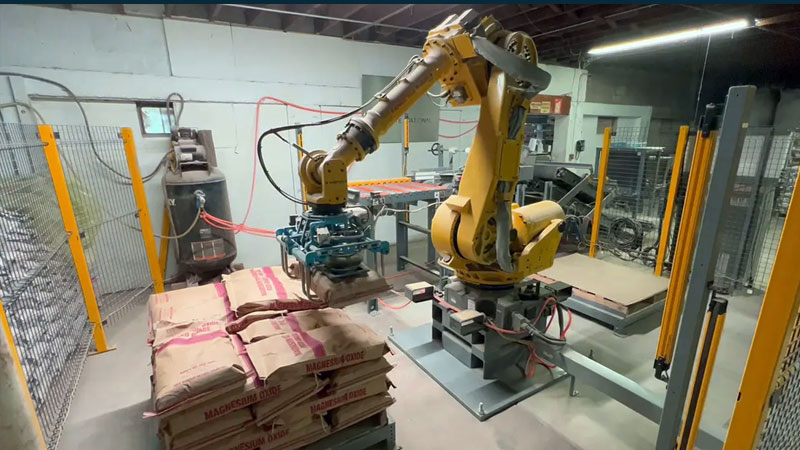
A dual-robot 90-lb. concrete bag palletizing system offers a practical solution for manufacturers seeking to automate one of the most physically demanding steps in the packaging process. By combining high-payload robotic handling, specialized bag gripping, intelligent pallet-pattern programming, and automated pallet movement, the system can significantly improve throughput while reducing repetitive manual lifting.
For high-volume concrete manufacturers, the investment in dual-robot palletizing can provide long-term benefits through increased production capacity, improved pallet quality, reduced ergonomic exposure, and greater consistency. With the proper system design, the two robots become an integrated part of the production line, providing reliable and repeatable palletizing performance around the clock.
High-Speed Handling of 90-Lb. Bags
A 90-lb. concrete bag is a substantial payload for manual handling, particularly when operators must repeatedly lift, rotate, and stack bags throughout an entire shift. The repetitive nature of the work can contribute to fatigue and ergonomic risks while limiting production speed.
The dual-robot configuration allows the system to handle a continuous stream of product. While one robot is placing a bag, the second robot can be performing another portion of the palletizing sequence. Depending on the required production rate, bag dimensions, pallet configuration, and conveyor arrangement, the robots can be coordinated to maximize system throughput.
Consistent Pallet Patterns
Proper pallet construction is critical when handling heavy bags. Poorly positioned bags can create unstable loads that shift during storage, transportation, or forklift handling.
Robotic palletizing provides precise and repeatable placement of every bag. The system can be programmed to create interlocking patterns in which successive layers are rotated or offset to improve load stability. Multiple pallet recipes can also be programmed into the robot controls, allowing the same equipment to handle different bag sizes, pallet dimensions, or stacking configurations.
The robots can also be programmed to maintain consistent bag orientation and layer positioning. This produces a cleaner, more uniform pallet while reducing the variability associated with manual stacking.
Dual-Robot Advantages
The primary advantage of using two robots is increased production capacity. Instead of relying on one robot to complete every pick-and-place operation, the workload can be distributed between two machines.
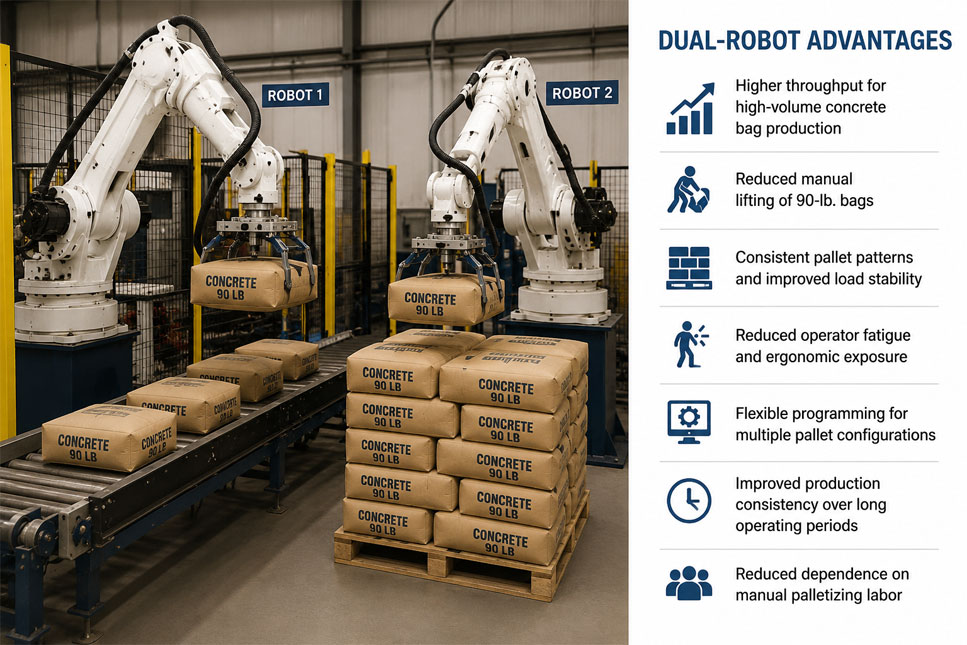
A properly engineered dual-robot cell can provide several important benefits:
The robots can be equipped with specially designed bag grippers capable of securely handling the heavy, flexible nature of concrete bags. Gripper design is particularly important because the system must provide sufficient gripping force without damaging the packaging.
Integrated Palletizing Cell
A complete dual-robot palletizing system typically includes more than the robots themselves. The cell may incorporate product infeed conveyors, bag positioning equipment, pallet dispensers, pallet conveyors, safety fencing, light curtains or area scanners, controls, and operator interfaces.
Empty pallets can be automatically delivered into the palletizing position, while completed pallets can be conveyed out of the cell for wrapping, storage, or shipment. Stretch wrapping and other downstream equipment can also be integrated to create a highly automated packaging operation.
Safety is an essential component of the system. Because two industrial robots are operating around heavy payloads, the palletizing cell should be engineered with appropriate guarding, safety-rated controls, emergency stops, access gates, and protective devices. The overall system should be evaluated in accordance with applicable machine-safety requirements.
Improving Productivity and Workplace Safety
Automating the palletizing of 90-lb. concrete bags allows personnel to focus on machine operation, quality control, material supply, and other higher-value activities rather than repetitive heavy lifting. The result is a safer and more productive working environment.
A dual-robot system also provides predictable production performance. Robots can operate continuously at programmed speeds without the fatigue that naturally affects manual operators. This makes automated palletizing particularly attractive for facilities operating multiple shifts or requiring high daily production volumes.