Digital Proof of SOP Compliance Using Camera and AI
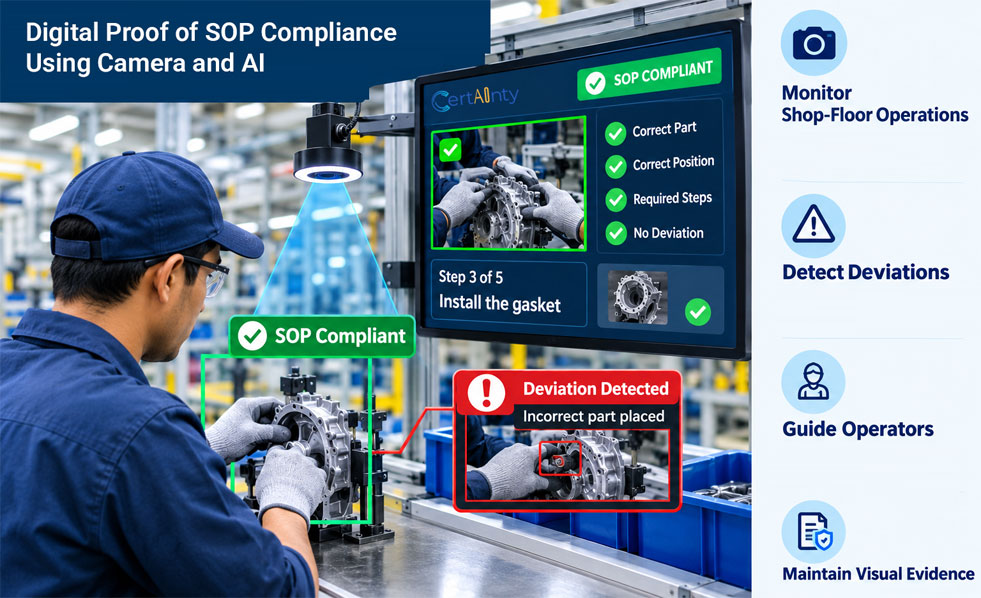
In manufacturing, following Standard Operating Procedures (SOPs) is critical to ensuring product quality, process consistency, operational safety, and regulatory compliance.
How do manufacturers prove that every step of an SOP was actually followed?
Traditional manufacturing systems often rely on manual checklists, operator confirmations, supervisor observations, or final quality inspection. While these methods provide some level of process control, they do not always provide objective evidence of how the work was performed.
An operator may unintentionally:
These mistakes may go unnoticed until a defect is discovered later in production—or even after the product reaches the customer.
Intelgic’s AI-powered SOP Monitoring System changes this approach.
Using industrial cameras and advanced Computer Vision AI, Intelgic continuously monitors shop-floor activities, verifies observable SOP steps, detects process deviations, provides real-time corrective guidance, and creates digital visual evidence of the operations performed.
The result is a system that not only helps manufacturers enforce SOP compliance but also creates digital proof of how each process was executed.
Why Traditional SOP Compliance Verification Is Not Enough
Manufacturing SOPs define the correct sequence of operations, required components, tools, inspection checkpoints, and quality requirements.
However, verifying that operators consistently follow these instructions can be challenging, particularly in complex manufacturing environments. Common challenges include:
Operators unintentionally miss required operations.
Activities are performed in the wrong order.
Incorrect components or product variants are used.
Required assembly, placement, inspection, or verification activities are not completed.
Operators make mistakes due to fatigue, distractions, or process complexity.
Traditional systems may record that a task was completed without capturing how it was performed.
When a defect or customer complaint occurs, manufacturers may have no objective record of the actual process.
Indicates that an operation was acknowledged.
Helps demonstrate what actually happened during execution.
Intelgic AI-Powered SOP Monitoring System
Intelgic uses cameras and Computer Vision AI to monitor manufacturing operations as they happen. Cameras installed around the workstation observe the relevant process activities, components, tools, and assembly areas.
The AI analyzes video streams and compares observed activities against the predefined SOP. The system can identify whether required steps are completed, whether operations occur in the correct sequence, and whether any defined process deviation has occurred.
The monitoring process follows a continuous cycle:
Unlike traditional inspection systems that focus primarily on the finished product, Intelgic monitors the process used to manufacture it.
Real-Time SOP Deviation Detection and Operator Guidance
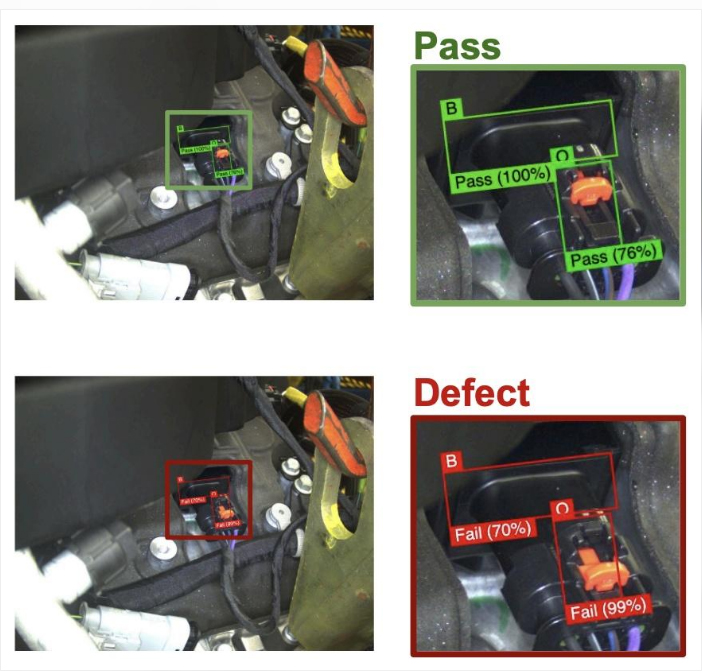
One of the most important capabilities of Intelgic’s SOP Monitoring System is detecting errors while the operation is still in progress.
Consider an automotive assembly process where an operator must install multiple components in a predefined sequence. If the operator skips a required component and proceeds to the next operation, the AI can identify the missing step and immediately notify the operator. For example:
Instead of discovering the missing connector during final quality inspection, the system helps the operator correct the mistake at the point where it occurs. Depending on the application, alerts can be delivered through:
The objective is to prevent process deviations from becoming product defects.
Creating Digital Proof of SOP Compliance
Traditional quality records often show the final inspection result. Intelgic takes traceability further by creating a digital record of the manufacturing process itself.
The system can associate observed process events with the product, workstation, SOP, and production cycle. For each monitored operation, the digital record can contain:
This creates a structured history of the manufacturing process.
When a question arises about how a particular product was assembled or processed, quality teams can review the available digital evidence rather than relying entirely on manual records or recollection.
Record the Entire Process or Only Important Events
Different manufacturing environments have different requirements for video recording, storage, and traceability. Intelgic supports two primary recording approaches.
The system can record the complete manufacturing operation from beginning to end. This provides a visual history of the monitored process, allowing authorized personnel to review the execution of individual SOP steps.
Particularly valuable for complex assemblies, critical manufacturing operations, and processes where detailed historical evidence is required.
Instead of storing the complete process video, the system can capture and retain specific events, such as:
For example, when AI detects a missing assembly step, the system can retain a video clip showing the deviation and subsequent correction. This can reduce storage requirements while preserving evidence of important quality-related activities.
Manufacturers can configure recording and retention policies according to their operational, privacy, and compliance requirements.
From SOP Monitoring to Digital Process Traceability
A conventional manufacturing quality record may indicate whether a product passed—but it may not explain how the product was manufactured. With Intelgic’s AI SOP Monitoring System, the digital record can provide much greater detail.
This creates a digital process history that can be linked to the individual product or production batch.
Manufacturers gain visibility into not only whether a product passed inspection, but also whether the monitored manufacturing process followed the defined procedure.
Visual Evidence for Quality Audits and Investigations
When a customer reports a product defect, manufacturers often need to investigate how the product was assembled, processed, or inspected. Without detailed process records, identifying the root cause can be difficult.
Intelgic’s SOP Monitoring System can help quality teams review relevant process events and visual evidence. For example, investigators can examine:
This evidence can support:
Digital visual evidence provides an additional layer of confidence beyond manual checklists and self-reported process completion.
The scope of compliance evidence depends on what the cameras and AI can reliably observe. Processes requiring verification of hidden operations, torque values, electrical measurements, or other nonvisual parameters may require integration with additional sensors or manufacturing systems.
AI-Powered Manufacturing Process Analytics
Digital SOP monitoring creates another important opportunity: understanding what actually happens on the shop floor.
Manufacturing operations generate enormous amounts of process information that traditional systems often do not capture. Intelgic converts observable shop-floor activities into structured operational data. The system can provide insights such as:
Percentage of monitored process cycles completed according to defined SOP requirements.
Time required to perform individual SOP operations.
How often particular SOP steps are missed or performed incorrectly.
Time taken to rectify identified process deviations.
Identification of SOP steps or operations that frequently generate mistakes.
Manufacturing operations that consistently require more time than expected.
Analysis of process performance across workstations, shifts, product variants, and production periods.
This information helps manufacturers identify opportunities to improve:
Applications of Digital SOP Compliance Monitoring
Intelgic’s AI-powered SOP Monitoring System can be used across a wide range of complex manufacturing operations.
Monitor component assembly, connector installation, fastening sequences, part placement, and other visually verifiable manufacturing steps.
Create visual process records for complex component installation, assembly sequences, and defined verification activities.
Monitor the installation of circuit breakers, relays, contactors, terminal blocks, wiring components, and other electrical equipment.
Support process monitoring and traceability for defined assembly, handling, and inspection operations.
Verify component placement, assembly sequences, connector installation, and other observable production activities.
Monitor the assembly of pumps, motors, valves, gearboxes, mechanical systems, and complex industrial equipment.
Monitor defined component placement, module installation, connector assembly, and other observable process steps.
Verify that the correct components and quantities are packed according to the required packing SOP.
Benefits of Digital Proof of SOP Compliance
Detect deviations while the operator is performing the operation and provide immediate feedback.
Maintain images, video clips, and structured event records of monitored SOP activities.
Associate process events and verification results with individual products, workstations, or production batches.
Provide organized digital records that can support process reviews, internal audits, and quality investigations.
Identify and correct assembly or process mistakes before they progress to downstream manufacturing stages.
Continuously verify observable operations against defined process requirements.
Generate step-level cycle times, deviation statistics, corrective-action records, and other operational insights.
Use historical data to identify recurring errors, optimize SOPs, and improve process consistency.
From Paper-Based SOPs to AI-Verified Process Execution
Tell operators
what they should do.
Record
what operators report they have done.
Observes
what is actually happening, verifies defined steps, and creates visual evidence.
This transforms SOP compliance from a largely manual documentation activity into an automated, evidence-based process.
The AI continuously monitors the workstation, identifies deviations, guides corrective actions, and records relevant events for future reference.
The result is not simply a digital checklist. It is an intelligent SOP verification and process traceability system that helps manufacturers improve quality, prevent errors, and build a reliable digital history of shop-floor operations.
Frequently Asked Questions
What is digital proof of SOP compliance? +
Digital proof of SOP compliance is a record demonstrating how defined manufacturing procedures were executed. It may include verified process steps, timestamps, images, video clips, deviation records, and corrective-action evidence.
How can cameras and AI verify SOP compliance? +
Cameras capture observable manufacturing activities, while Computer Vision AI analyzes the images or video to recognize components, actions, and process events. The system compares these observations with predefined SOP requirements and identifies deviations.
Can AI detect SOP violations in real time? +
Yes. When the required process activities are visually observable and the AI has been configured to recognize them, the system can detect defined deviations and provide real-time alerts.
Can the system guide operators to correct mistakes? +
Yes. Intelgic’s SOP Monitoring System can notify operators when a required step is missed or incorrectly performed and provide instructions for corrective action through an integrated display or notification interface.
Does the system record the complete manufacturing process? +
The system can be configured for continuous process recording or event-based recording, depending on the application’s requirements and available storage infrastructure.
Can AI record only SOP failure events? +
Yes. The system can retain images or video clips associated with defined SOP deviations, alerts, and corrective actions instead of recording every moment of the production process.
Can the digital records be used for quality audits? +
Yes. Digital SOP records can support internal quality audits, customer investigations, process verification, and traceability. Whether they satisfy a particular regulatory or certification requirement depends on the applicable standard and the system’s validated configuration, access controls, record integrity, and retention procedures.
Can the system identify which SOP steps frequently cause errors? +
Yes. The system can analyze historical deviation records to identify recurring process errors, frequently missed steps, and operations that may require additional training or process improvements.
Can Intelgic integrate SOP monitoring with MES or ERP systems? +
Yes. Intelgic’s system can integrate with MES, ERP, PLCs, production databases, barcode systems, and other factory applications through supported interfaces.
Can one system monitor multiple SOPs and product variants? +
Yes. Recipe-based monitoring allows different products, workstations, and processes to use their corresponding SOP definitions, AI models, verification rules, and acceptance criteria.
Create Digital Proof of Every Critical Manufacturing Process
Manufacturing quality should not depend only on whether an operator checked a box or whether a finished product passed inspection.
Manufacturers need visibility into how the process was performed, whether the SOP was followed, what errors occurred, and how those errors were corrected.
Intelgic’s AI-powered SOP Monitoring System combines the following to create an intelligent process monitoring platform:
From automotive and aerospace assembly to electrical control panels, industrial machinery, medical devices, and packaging operations, Intelgic helps manufacturers transform shop-floor activities into verifiable digital records.
Contact Intelgic to learn how AI-powered SOP monitoring can create digital proof of process compliance across your manufacturing operations.
Contact Intelgic →